
Sports Injuries in East Auckland: What to Do, When to Seek Care, and How to Recover
Whether you have rolled your ankle on the touch rugby field, strained your shoulder in the pool, or felt something give in your knee on a trail run — getting the right assessment and care early makes a genuine difference to how quickly and completely you recover.
At Velca in Howick, physiotherapy and chiropractic are both available for sports injuries, and most injuries sustained in New Zealand are covered by ACC. You do not need a GP referral.
Part 1: The First 48-72 Hours — What to Do
Current evidence-based guidance has moved away from the old RICE approach in favour of the PEACE & LOVE framework, which acknowledges the body's need for controlled movement and load:
Protection — avoid activities that provoke significant pain in the first few days, but do not completely immobilise the area
Elevation — elevate the injured limb where practical to reduce swelling
Avoid anti-inflammatories — there is growing evidence that the inflammatory response is part of the healing process
Compression — compression bandaging can help manage swelling in limb injuries
Education — understanding that early pain does not necessarily indicate serious damage
Load — progressive mechanical loading of the injured tissue, guided by pain, supports healing
Optimism — a positive expectation of recovery is associated with better outcomes
Vascularisation — low-impact cardiovascular activity supports blood flow early in recovery
Exercise — targeted rehabilitation exercise to restore strength, range of motion, and function
A physiotherapy or chiropractic assessment at Velca within the first few days helps you understand what has happened, how significant it is, and what the right approach looks like for your specific injury.
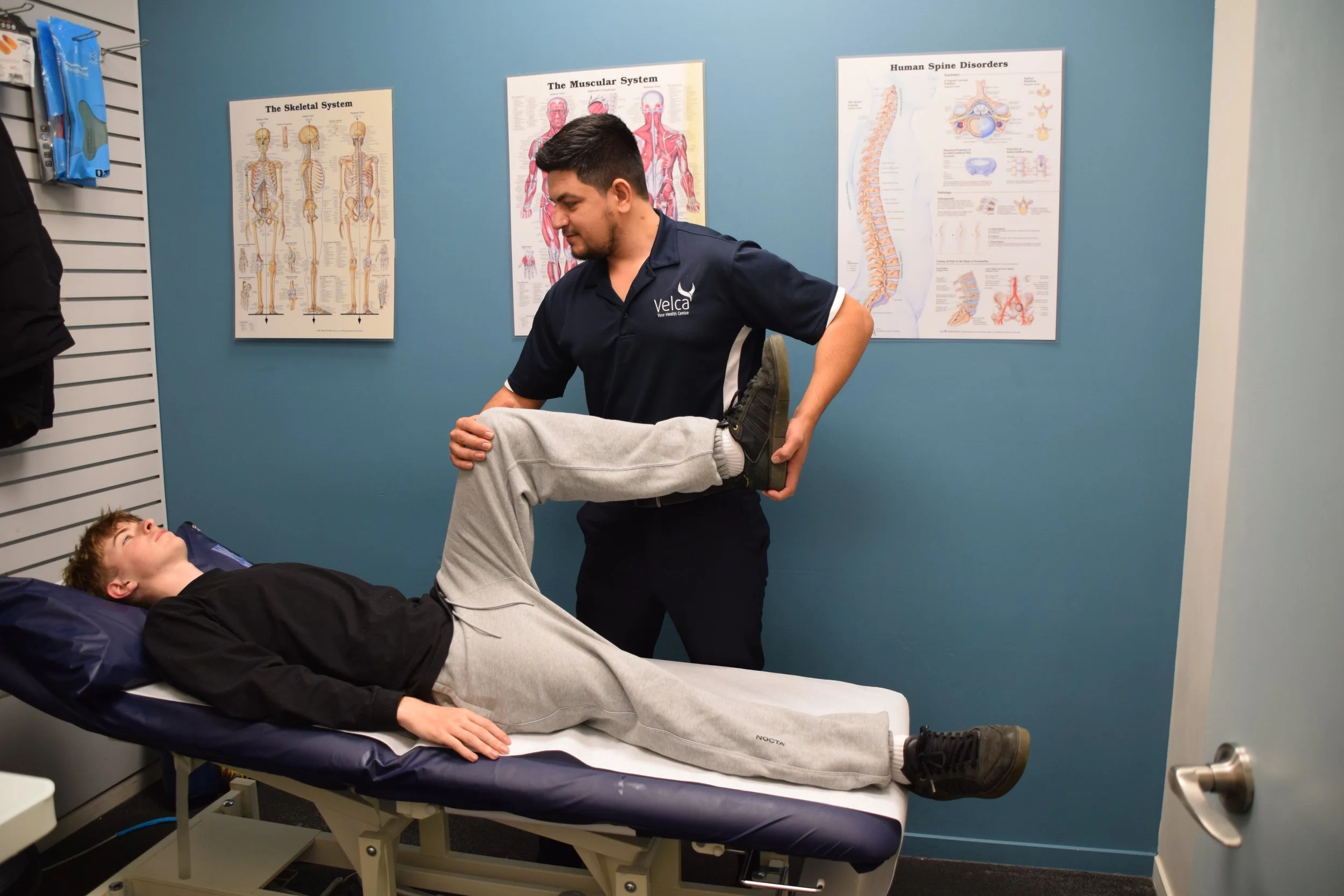
Sports physio at Velca includes comprehensive assessment of extremity joints as well as the spine.
Part 2: What Physiotherapy Offers
Physiotherapy is the core discipline for most sports injury rehabilitation. At Velca, this may include:
Accurate assessment of the injured structure, including clinical testing and liaison with imaging services where relevant
Hands-on manual therapy to reduce pain and restore joint movement in the early phase
A progressive rehabilitation programme designed around your sport and your specific goals
Return-to-sport testing — assessing whether you have regained the strength, power, and movement quality needed to return safely
Advice on taping, bracing, or orthotics where relevant
Part 3: What Sports Chiropractic Offers
Sports chiropractic at Velca goes beyond spinal care. Our chiropractors are trained in extremity adjusting — assessing and working with joints throughout the body including ankles, knees, hips, shoulders, elbows, and wrists. For sports injuries, chiropractic may be offered for:
Assessment and management of joint dysfunction anywhere in the body
Sports-related spinal complaints including acute low back pain from lifting or contact
Biomechanical assessment of movement quality and factors that may contribute to injury risk
Co-management alongside physiotherapy where joint mobility and rehabilitation are progressed together
Part 4: ACC and Sports Injuries
The vast majority of acute sports injuries in New Zealand are covered by ACC — including muscle strains, ligament sprains, joint injuries, fractures, and soft tissue injuries from accidents during sport. At Velca, we are an ACC-registered provider and can lodge your claim at your first appointment with no GP referral required.
Part 5: Common Sports Injuries We See at Velca
Ankle sprains — the most common sports injury, frequently under-rehabilitated and prone to recurrence
Knee ligament injuries — assessment, pre-surgical rehabilitation, or conservative management depending on severity
Shoulder injuries — rotator cuff strains, AC joint injuries, shoulder instability
Hamstring and quad strains — common in running and field sports
Tennis and golfer's elbow — overuse tendinopathies at the elbow
Wrist injuries — overuse or acute ligament sprains are the most common. Occasionally we get the unlucky athlete that has severely fractured their wrist
You can see our team of physios here, and our team of chiropractors here.
